
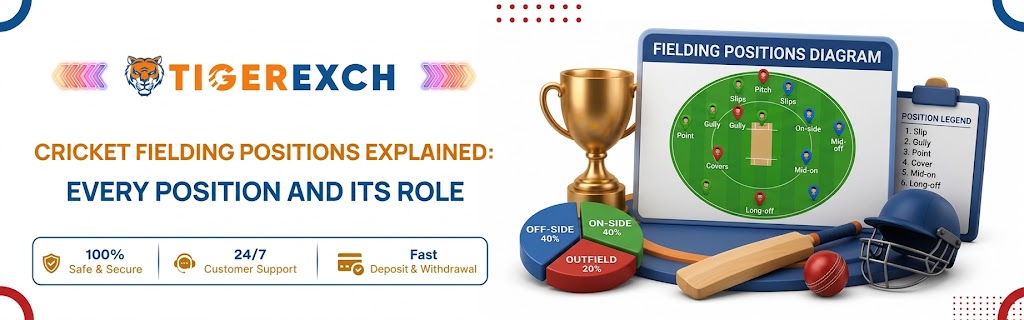
If you watch cricket, you will often hear the words “slip,” “gully,” “cover” “midwicket,” “third man,” etc without knowing exactly where these people stand or what they are supposed to do. Every fielding position is part of a plan of bowling, protecting an area to score runs or creating an opportunity for a catch. Knowing the cricket fielding positions helps make matches easier to follow. This beginner-friendly tutorial will help you understand the basic fielding areas, what they do, and how captains change them depending on the bowler batter and match scenario. Fielders are not always stationary in one area therefore, the same position can move during a match. Readers are advised to refer to authentic cricket websites like TigerExchange Pro for accurate match information
What are the cricket fielding positions?
Fielding spots are marked places where players stand during play when the bowling side tries to restrict runs or take wickets The ground is broadly divided into two halves, the off side and the leg side, or the on side.
The wicketkeeper stays behind the stumps. The captain can shift the other 9 fielders. Their positioning will depend on the bowler’s style, the batsman’s favored shots, and the situation of the current game. There are various positions that are known, but the captains only use the places that fit with their plan. BBC Sport’s handbook covers the essential positions—wicketkeeper, slip, gully, point, cover, third man, fine leg, and midwicket.
Cricket Fielding Positions Names, and Main Roles
The table below explains the most common cricket fielding positions’ names and their basic purpose.
| Position | Location | Main role |
| Wicketkeeper | Behind the stumps | Collects deliveries and takes edges or stumpings |
| Slip | Behind the batter on the off side | Catches edges from moving deliveries |
| Gully | Between slip and point | Covers wider edges and deflections |
| Point | Square on the off side | Stops cuts and square shots |
| Cover | In front of point | Fields drives through the off side |
| Mid-off | Near the straight off side | Stops drives and controls singles |
| Mid-on | Near the straight leg side | Covers straight drives and quick runs |
| Midwicket | Square on the leg side | Stops pulls, flicks and worked shots |
| Square leg | Square on the leg side | Covers sweeps and leg-side shots |
| Fine leg | Behind square on the leg side | Stops glances and deflections |
| Third man | Behind the wicket on the off side | Covers edges and shots behind point |
These positions can shift closer to the bat or further back depending on if the captain wants a catching opportunity or greater run protection.
Defensive Off-Side Positions
The key fielding positions in cricket on the off side in cricket are slip, second slip, gully, point, backward point, cover, extra cover, mid-off, and third man.
Slip fielders stand behind the batsman and try to catch edges from balls that move away from the bat. gully broader than a slip and capable of catching angled edges or late deflections Point and backward point guard square cuts. Cover and extra cover safeguard drives played in front of the square.
The mid-off is frequently a straighter option and is used to stop firm drives or rapid singles The third man stays behind the wicket and can preserve runs off outside edges or deflections. If a left-handed batter faces the bowler, the angles change because the off-side is reversed.
Leg-side cricket fielding positions
Leg-side group: leg slip, short leg, forward short leg, square leg, backward square leg, midwicket, deep midwicket, mid-on, fine leg, and long-on.
These players control shots played at the batter’s pads or toward the on side. Pulls, flicks, and sweeps are defended by midwicket and square leg. The fine leg stops it behind square, and the mid-on is there to guard the straight leg side.
Short leg and forward short leg are close to the batsman and often employed against spin or when the captain wants to apply pressure In limited-overs cricket, deep square leg, deep midwicket and long-on might be put near the boundary to stop big hits
Catching Close Positions
Close catchers stand near the bat to increase the chances of taking wickets. The gully is for the angled shots between the slip cordon and point—the first and second slip are for the edges. A silly point is put very close to the off side, and a short leg is placed close to the leg side.
The leg slip is used to catch sharp edges behind the batsman. Quick reactions and the right protective equipment when needed are required for these roles Close catching areas are particularly beneficial for moving balls bouncing irregularly or balls with a strong curve
Technology and visual tools such as Tigerexch AI artificial intelligence can assist readers in studying tactical patterns, but no technology can guarantee the outcome of a match.
Cricket Field Placement in Various Match Formats
The cricket field placement is dependent on the format and the number of overs available.
In Test cricket, captains can employ a number of close catchers because sustained pressure and wickets are more important than constant boundary protection. Slip, gully, short leg, and stupid point may be utilized during an attacking spell.
The field in ODI cricket often varies in the powerplay, middle overs, and death overs. Captains need to balance the need to catch and the need to protect the boundary.
In T20 cricket there are fewer deliveries for the hitters to face; hence, boundary protection is a big focus. Deep fielders, ring fielders, and scheduled bowling changes are factors that affect the captain’s choice. Restrictions on field placement also specify how many fielders can be placed outside the inner circle at various stages of IPL matches. Remember, field placements can be changed immediately after a wicket, boundary, bowling change, or tactical timeout in live betting IPL.
How Captains Select a Field:
Captains must decide carefully where to place their fielders:
- The pace of the bowler, swing, seam movement, or spin.
- The batter’s power zones.
- Whether the ball is new or ancient.
- Bounce and pitch behavior
- Size of border.
- Run rate required.
- Wickets in the bag.
- Stage of the innings.
If a batsman consistently smashes outside off stump, the captain could put a slip, gully, and cover fielder and encourage the bowler to attack that area. Therefore, the pitch is part of a tactical scheme, not a haphazard setup.
Reading a Cricket Fielding Map
In a cricket fielding map the batter and wicketkeeper are normally in the middle, and positions are set out around the pitch like the points of a clock.
First find the batter’s stance. Then find the off side. Then find the leg side. Then find the wicketkeeper, close catchers, inner ring, and deep boundary fielders. The diagrams may be a little different, as players can be wider, finer, squarer, or straighter and still be defined by the same overall position.
Fielding Common Mistakes Beginners Do
- Gully with a point confusing
- Mid on confused with mid off.
- Consider the fine leg and square leg as one posture.
- Assuming a fielder has to be at one particular spot.
- Forgetting that lefties and righties modify the angles.
- Ignore format-based fielding constraints.
- Boundary riders only. Lost near catchers.
If you are looking for an online betting ID India, then it is important to check the conditions, age requirements, and local rules that apply independently rather than believing in what is not confirmed.
Position on the Field and Game Analysis
Field settings might tip a captain’s hand. The slip and gully can suggest an attacking mindset, while deep midwicket and long-on can represent the captain’s protection of the boundary against leg-side power. But a field position alone can’t decide a result. Also bowling accuracy, batter form, pitch conditions, weather, match pressure, etc.
When a boundary is hit, a wicket falls, or the bowler changes, watch how the captain changes the cricket fielding positions. This can allow newcomers to learn the tactical side of the game. Field movement may be quite instructive while watching live matches especially in brief formats like IPL cricket
cricket fielding positions FAQs
1. Name the main fielding positions in cricket.
The major fielding positions include wicketkeeper, slip, gully, point, cover, mid-off, mid-on midwicket, square leg, fine leg, and third man
2. What is the job of a slip fielder?
A slip fielder tries to collect edges from deliveries that are going past the edge of the bat.
3. What is the difference between point and cover?
Point is a little nearer to the square of the wicket, while cover is farther up to the batter on the off side
4 At midwicket, where does a fielder stand?
Midwicket is a position on the leg side between square leg and mid-on
5. Why is there a gully fielder?
Gully covers edged or deflected strokes between the slip region and point.
6. Why do they utilize close catchers in cricket?
Close catchers force and look for mistakes around the plate especially on moving or spinning pitches
7. Are fielding positions established during a match?
No, the captains transfer the players as per the bowler, the batter, the format, and the match scenario.
8. What does a cricket fielding map show?
It gives the approximate positions of fielders around the pitch and the roles connected with those areas.
Final Thoughts
Understanding cricket fielding positions makes matches easier to follow because every fielder has a tactical role. Slip and gully are trying to get the edges; point and cover are covering the off side and midwicket; square leg and fine leg are covering the normal leg side shots. Fielding strategies alter with the batter, bowler, pitch, format, and desired run rate; therefore, positions should be considered as flexible pieces of a bigger strategy. A solid fielding map can assist novices link what they see on the screen with the captain’s plan on the pitch.