
Introduction
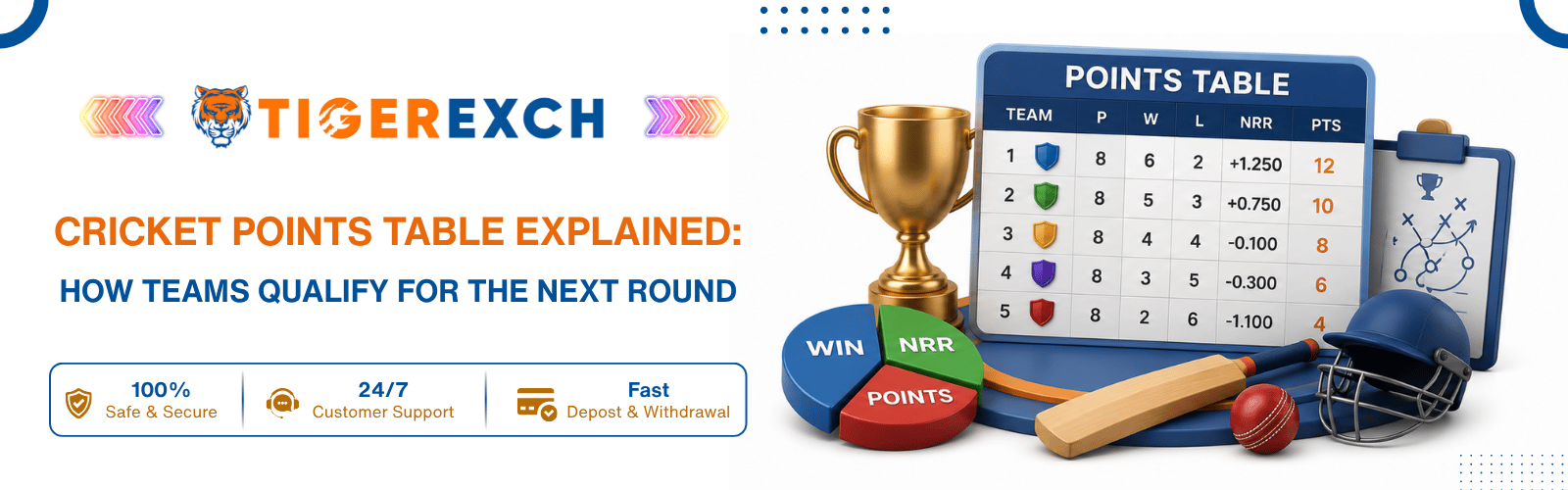
The Cricket Points Table is used to represent the position of teams in a competition and enables the viewers to know which teams are likely to qualify for the next stage. This helps readers to follow team position, matches played, wins, defeats, no-results, total points, and qualification status.
How Standings Are Calculated: The Cricket Points System Explained Why Rules Can Be Different Between Competitions Qualification Scenarios It’s not marketing hype. It’s real cricket expertise.
What is a points table in cricket?
A Cricket Points Table highlights the performance of teams in a group stage or league. It contains information like team name, matches played, wins, defeats, no-results, points, and current place
Teams are presented in a certain order depending on accrued points and, when appropriate, tie-breakers. Points are used to rank the teams and to identify which teams are moving on to qualification. Fans who are following events online may also come across portals like the Tiger Exchange 247 that provide cricket coverage when seeking match updates and digital tools
Cricket Points System Explained
Most limited-overs tournaments give points according to match results; however the format can vary Typical outcomes are victories, defeats, no results, and sometimes draws
Here is a table of a typical point system used in several leagues.
| Match Result | Points Usually Awarded | Explanation |
| Win | 2 | The team generally receives points for winning |
| Loss | 0 | The team generally receives no points |
| No Result | Usually 1 | Depends on tournament regulations |
| Tie | Tournament-specific | Rules can vary by competition |
Some contests give bonus points for reaching particular levels of performance Points systems differ; thus, readers should consult the relevant tournament regulations
How Cricket Points Table Works
The standings are a product of a number of variables The team name identifies the participant. Matches played: the number of matches played by a team.
Wins and defeats are results, whereas no results are matches that have been abandoned. The major means of ranking in many leagues is the points gained from the results of matches. The current position shows where the team stands against others.
Followers of live tournaments may also find match information and cricket updates using resources like Tiger Exchange 365. But the points table alone remains the major source to analyze the standings and qualification scenarios.
How Teams Proceed to the Next Round
Teams usually qualify from a group or league stage by finishing in predetermined qualifying positions. Points are important since more points usually mean higher places.
With every game the standings change. A win is worth points and could help for positioning; a defeat lets someone else get by. No results also affect overall points and qualification scenarios.
The final ranking is important because tournaments have rules about how many teams progress. Some championships have the top two teams going straight through to the semi-finals, whereas others may have further play-off matches. The number of teams that qualify is determined by tournament-specific rules.
Cricket Qualification Rules
The Cricket Qualification Rules are different for each competition. Typical forms include group stage qualifying, top spot qualification, and points-based rankings with tie-breakers where necessary.
Teams finishing in qualifying positions proceed based on points and, where applicable, other criteria. Some competitions have super stages, eliminators, or qualifications to choose the final competitors.
When looking for digital cricket experiences, users interested in cricket games or online services may also hunt for a cricket game ID qualification rules, however, they are still determined by official tournament regulations and not by third-party websites.
Cricket Points Table Rules Vary By Tournament
Rules of point tables are not the same in all cricket competitions. The allocation of points, number of qualifying teams, and tie-breaker methods might be different for T20 tournaments, ODI events, World Cups, domestic leagues, and group-stage competitions
The table below outlines the common columns in point tables.
| Column | Meaning | Why It Matters |
| Team | Name of the team | Identifies the participant |
| Matches | Games played | Shows tournament progress |
| Wins | Matches won | Usually contributes to points |
| Losses | Matches lost | Usually gives no points |
| No Results | Matches without a result | May affect total points |
| Points | Total points earned | Major factor in standings |
| Position | Current ranking | Shows where the team stands |
They are not the same for all the tournaments. Exact requirements should be sought in the official competition regulations.
What if the Teams Have the Same Points?
Some events use a tiebreaker to decide their order in case of a points tie. In some competitions they utilize net run rate to separate teams, but not all competitions.
Other factors can include head-to-head, the number of wins, or rules particular to the competition. The full protocol is detailed in the official playing conditions.
How to read a cricket league table
Beginners, look for the following in order: Team Name Matches Played Wins Losses No-Results Points, Position, and Qualification Status. This step-by-step strategy helps avoid frequent blunders such as disregarding remaining matches or misinterpreting standings
Readers comparing terminology for accounts across platforms may also see references to a Trusted Online Betting ID when they read about online account verification But the points table itself can be understood with official tournament statistics and rankings
A Simple Qualification Example
Let us choose four hypothetical teams: Alpha, Beta, Gamma, and Delta. Alpha has 6 points, Beta has 4 points, Gamma has 2 points, and Delta has 0 points after three matches. If Beta wins its next two matches, it might reach eight points and leapfrog Alpha if Alpha loses both matches
This example is for illustrative purposes only and does not reflect actual tournament fact. It displays how match results can influence wins, points, position in the table and qualifying probabilities
FAQs
What is the Cricket Points Table?
A Cricket Points Table shows the list of teams participating in a tournament and shows the matches played, wins, losses, points, and position to reflect the qualification status
How does the Cricket Points System work?
Most competitions provide points for victories ties and no results, but the specific structure varies Most systems award two points for a win and one for a draw or no result
How does a team get into the following round?
Teams qualify based on the number of points they accumulate plus any tiebreakers stipulated in the tournament rules if necessary
What happens if two teams have the same points?
In tournaments, teams tied on points can be separated by tiebreakers such as net run rate, head-to-head records or other factors
Can the Cricket Points Table Rules be for different tournaments?
Yes, the way points are allocated, qualification forms and tie-breakers might differ among T20 leagues and ODI events World Cups and domestic championships
Summary
The Cricket Points Table assists fans to know the status of teams, points, and qualification possibilities in cricket events The teams that qualify to the next round are determined by points position remaining matches and official tiebreakers
The procedures for qualifying can differ from one competition to another; thus readers should consult the official tournament regulations for the precise criteria Knowing how points are scored, how standings are arranged and how teams qualify makes following a tournament more informed and cuts down on common misconceptions
Read More
https://tigerexch.ing/net-run-rate-in-cricket-formula-examples-and-rules/
https://tigerexch.ing/dls-method-in-cricket/