
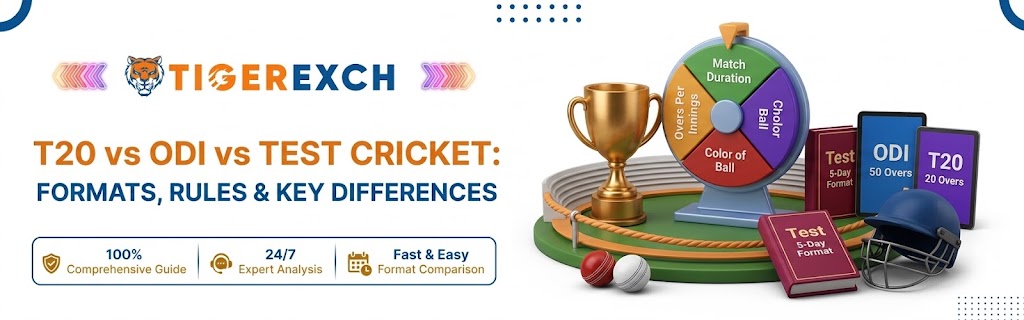
Fans on the hunt for T20 vs ODI vs Test usually want a clear picture of how the three major men’s international cricket formats differ. Each format has its own match length, amount of overs, rules, scoring patterns, player roles and tactics.
This article explains those distinctions in plain terms so that beginners can grasp what makes each format different and why some players are better at one than the other.
T20 vs ODI vs Test—Short Comparison Table
| Feature | T20 | ODI | Test |
| Overs per side | 20 | 50 | No fixed innings-over limit |
| Typical duration | Around 3 hours | Around 7–8 hours | Up to 5 days |
| Innings per team | 1 | 1 | Up to 2 |
| Main focus | Fast scoring, aggression | Balance of attack and control | Long-form strategy, endurance |
This table is the main cricket format explained in one view. T20 is built for speed ODI for a blend of pace and preparation and Test for patience and technique over multiple days.
T20 Cricket Format
T20 is the shortest format of international cricket with each team facing 20 overs. Most games are roughly three hours long, making them great for prime time watching.
Features Include:
- The powerplay overs saw aggressive batting from the get go.
- The finisher and death bowling is the key in the last few overs.
- Captains opt for more aggressive field settings and more variations in their bowling.
The main difference between T20 and ODI is that in T20 you have to make an immediate impression. One over can change the game.
One-Day International Cricket
Each side bats for a maximum of 50 overs in an innings in an ODI. Matches usually span an entire day which gives teams more time to build up and recover.
Important points:
- Fielding early on is restricted by powerplays.
- Middle overs are about partnerships and controlled aggressiveness and rotation.
- Bowler and pitch settings are changed to regulate run pace and wickets.
This is where the contrast between T20 ODI and Test cricket becomes most apparent. ODI is the velocity of T20, with the strategic depth of Test.
Test Cricket mode
Test is the classic type of long-form cricket played over a maximum of five days, with two innings for each team. An innings has no over limit. Teams bowl until all the wickets fall or a declaration is made.
Key takeaways:
- Batters value Patience, Technique & Long Innings.
- Bowlers plan spells over sessions and days.
- Captains look at session-by-session targets and follow-on regulations.
When the discussion about ODI vs Test cricket arises, it is frequently said that test matches are the most rewarding of endurance and tactical planning compared to other formats.
T20 vs ODI vs Test—Important Rule Differences
When you compare T20 vs ODI vs Test t side by side, the rule differences define the game.
- Overs: 20 in T20, 50 in ODI, unlimited in Test innings
- Innings: One for each side (T20 and ODI), up to two (Test).
- Match length: hours in T20, day in ODI, up to five days in Test.
- Powerplays: Strict in T20 and ODI. Flexible in Test. Fielding limits.
- Tactics: T20 is aggressive ODI is a mix of assault and control and Test is about endurance and long term strategy.
These limits also directly influence the roles of players and the makeup of the squad for each format.
T20 vs ODI—Which One Is Quicker?
If you question which is faster T20 vs ODI, the answer is T20 for sure. 20 overs are limited therefore, hitters need to score fast from ball one and bowlers are always under pressure.
In ODI cricket you have more time to build an innings, rotate strike and recover from early losses. The scoring rate is normally lower and captains can play more defensively.
Both forms require skill but T20 is a game of explosive talent and ODI is a game of consistency and game management.
T20 vs Test Cricket—Biggest Differences
T20 versus Test cricket is a comparison of the largest gap in the game. T20 is around three hours; test matches can run for five days.
- Batting style: T20 players like to get aggressive early on Test cricketers like to bat through the crease
- Bowling workload: T20 bowlers bowl short high intensity periods Bowlers eye long spells through sessions
- Physical and mental needs T20 is a game of fast bursts Test cricket tests fitness and adaptation across days.
Test matches are far more affected by things like pitch wear and weather.
What is the difference between ODI and Test cricket?
The most noticeable difference between ODI and Test cricket is the over limit and length of match. In an ODI each innings is limited to 50 overs per team. In a test, each innings can last until all wickets are lost or a declaration.
Other distinctions…
- Powerplay restrictions have a big impact on ODI fielding positions; Test fielding positions are more variable.
- Bowling spells in ODI are shorter and more rotational; in Test, bowlers can bowl longer spells.
- In ODI, risk management is about run rate, in Test, it’s about saving wickets and time.
Those characteristics produce quite distinct styles of captaincy and batting.
Cricket’s Best Format For Different Fans
It all depends on what you like as a spectator. With cricket formats described simply:
- T20: For those who prefer the speed, hard hits and quick results.
- ODI: Ideal for those seeking a balance of pace and traditional cricket format.
- Test: Perfect for those who like skill, extended innings and strategic fights fought over days.
All three formats are there because they provide you different sorts of thrill.
Cricket Platforms and Format Information
As readers learn about formats, they will come across many cricket related platforms, which include match facts, stats, and live updates. While looking for cricket tiger exch247.
Treat such platforms as informational sources and always verify the authenticity before sharing any personal details.
Glossary of Online Cricket
Words about internet services for cricket commonly accompany searches of format type in search results. You may see a tiger exchange betting site blended with cricket analytical articles.
We have to differentiate format education from platform marketing and we have to accept that one doesn’t validate the other.
Mobile Cricket Access and APK Security
Fans are looking for mobile apps to monitor scores and highlights. If you are searching for the TigerExch app download APK, complete some simple safety checks.
Check the publisher and source.
- Carefully review app permissions.
- Do not use modded or unknown apk files.
- Safe mobile access protects your device and personal data.
- Cricket Account Terminology
When you browse through online cricket services, you can encounter words linked to user accounts and IDs. For example, there are pages that talk about the Tiger Exchange 247 ID about registration or access.
Note that these are platform-specific words and not part of any official regulations of T20 vs ODI vs Test cricket.
Terms of Registration
Searches involving cricket platforms also use registration and sign-up jargon. When searching for information on an account, you could come across phrases like Tiger Exchange sign up.
Remember that an account on any site does not equate to knowing the formats and regulations of cricket.
More Cricket Search Platform
Users also search for brand names when looking for live updates, instructions, or match info. There will be words like Tiger365 and debates about format and team news.
Make sure you’re on an official cricket information site or a third-party platform before you trust the content.
FAQs
What is the difference between T20 vs ODI vs Test?
T20 is 20 overs a side and takes roughly three hours, ODI has 50 overs and takes a day, Test cricket can last five days with two innings per team.
How many overs are played in T20 & ODI cricket?
T20 matches are played with 20 overs per innings per team and ODI matches are played with 50 overs per innings for each side.
Why is test cricket played for five days?
Test cricket has no limit on the number of overs per innings and allows two innings per team so matches are scheduled for up to five days to allow for long play.
What is the shortest format?
T20 is the shortest format of international cricket and usually lasts roughly three hours.
Why is Test cricket a long form of cricket?
It lasts up to five days, with two innings for each side and no definite limit on the number of overs, and it is a test of stamina, skill and long-term strategy.
Conclusion
T20 vs ODI vs Test cricket are three different sensations—pace, balance, and stamina. Understanding the difference between T20, ODI, and Test helps fans understand why different players and teams are good in different formats.
For the uninitiated: T20 is all about fast entertainment ODI is about pace and strategic equilibrium and Test cricket is about technique patience and long-term strategy.
Read More
Cricket Fielding Positions Explained: Every Position and Its Role